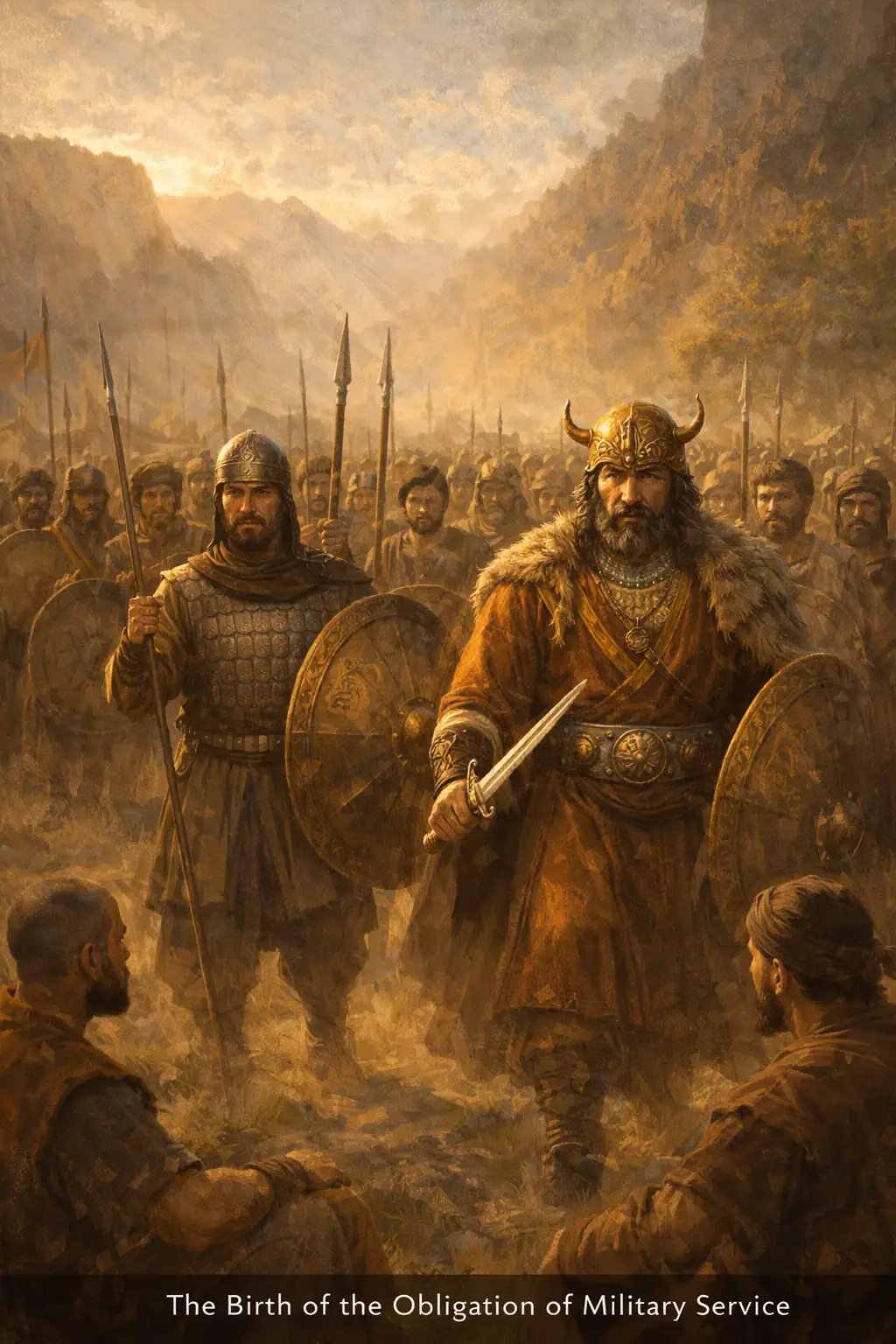
In a period whose exact date we cannot determine, in a land bordered on one side by the present-day Hezar-Masjed Mountains and on the other by the Hamun lake, a man from the class of heroes appeared who was called “Narman.”
Narman, who is known in Iranian epic tales as Nariman, was a tall and broad-shouldered man with a wide chest, a slender waist, powerful arms, golden hair, and a fair and radiant face.
Narman was a rider, but not on a horse; rather, he rode a bull, and according to legend—which differs from history—he even rode a rhinoceros.
Narman lived by animal husbandry and was also the leading elder of Iranian heroes.
In later periods, when heroism became a distinct profession, Iranian heroes no longer earned their living through agriculture or animal husbandry, but rather heroism itself had a specific income and they lived on its proceeds. However, in Narman’s time, the class of heroes had not yet become separate, and those who practised physical training and feats of strength retained their occupations in agriculture, animal husbandry, or craftsmanship.
Narman himself was a hero and trained a number of apprentices. After he married, he had a son whom he named “Sam” or “Sām.” One day, after Sam’s mother had nursed her infant son in the wilderness, an eagle descended from the sky, seized Sam in its talons, and carried him to the top of a mountain.
This event—whether it occurred to Sam or to one of his descendants—is rationally acceptable, because large eagles are capable of lifting even an adult human from the ground and carrying him away.
Today, those large eagles known in South America as “condors” do not exist in Iran, but perhaps such eagles lived in Iran in ancient times. What is contrary to reason, however, is how Sam survived in the eagle’s nest after being taken there, and how the eagle and its chicks did not kill the child.
The eagle that carried Sam was seen by the child’s mother. She informed Narman of the event, and he went to the mountain and brought back the child unharmed.
We do not have sufficient information about Narman’s way of life; we only know that he was a heroic and handsome man who lived by animal husbandry and raised his son Sam to be a hero like himself.
Sam surpassed his father Narman in stature and build, rode a horse, and was the one who established the first cavalry army in Iran.
At that time, Iranians rode horses, but they did not possess a cavalry army by which they could repel invaders.
By creating a cavalry army, Sam or Sām placed an effective military instrument at the disposal of the Iranians, and during his era horsemanship and wrestling developed greatly.
Sam was the one who established the principles of chivalry, which were as follows:
-
The duty of every man is that whenever his friends seek his help, he must hasten to assist them without delay and refrain from no sacrifice in helping them.
-
A pledge made by a man is sacred, and even at the cost of his life he must not violate that pledge.
-
Every man is obligated to go to war whenever Iran is exposed to danger and to repel or destroy the invaders and enemies of Iran.
The first time that going to the battlefield became the duty of every man was instituted by Sam, and this custom was established by the Iranians. It can be said that military service is an Iranian institution and that other nations learned this practice from the Iranians.
Some ancient nations, when they wished to wage war, sent slaves to fight and did not themselves enter the battlefield. Among some peoples, warfare was considered the duty of the common people, and the nobility regarded themselves as exempt from bearing arms and fighting. In ancient Rome, at first only slaves were sent to the battlefield, and later they learned from the Iranians that all men without exception must go to war.
But in Iran, where nobility had not yet emerged and slavery did not exist, according to the principle established by Sam or Sām, all men went to war whenever the danger of invasion arose—whether heroes, farmers, herders, or craftsmen.
In Iran, heroes did not have superiority over other classes, but they possessed the status of seniority, and people consulted them in matters.
Since the duty of going to the battlefield when Iran was exposed to the danger of invasion was assigned to everyone, all Iranian men learned the use of the various weapons of that time so that they could enter combat when war occurred.
Some imagine that in the heroic age of Iran the duty of fighting rested solely with the heroes and that others—namely farmers, herders, and craftsmen—did not go to war, unaware that heroes served as instructors and were sometimes entrusted with command of the army.
During the era of Sam or Sām, in addition to the establishment of a cavalry army and the institutionalisation of military service, the art of warfare was codified.
The necessity of preserving life and defending the land in which the Iranians lived compelled that people—who were the most peace-loving people in the world—to establish an army and formulate specific rules for war.
Other nations of the world, who in all matters were pupils of the Iranians and learned the ways of life and the secrets of civilisation from them, also learned the rules of warfare from the Iranians, and those rules still form the basis of modern warfare.
After learning the rules of warfare from the Iranians, other nations modified them according to their own interpretations and interests, and the Greeks created the formation known as the “phalanx.” However, the fundamental principle of warfare—namely dividing the army into two wings, a centre, and a reserve force—was a rule established by Sam or Sām, and this rule remained in force throughout all eras. Even the invention of firearms could not abolish the rule of warfare established by the Iranians.
Napoleon, in the wars of the early nineteenth century in Europe, and the commanders of the First World War in the first half of the twentieth century, followed this rule in all wars, and only the emergence and use of mechanised and armoured forces in the Second World War disrupted that military rule, eliminating the distinction between wings and centre on the battlefield.
