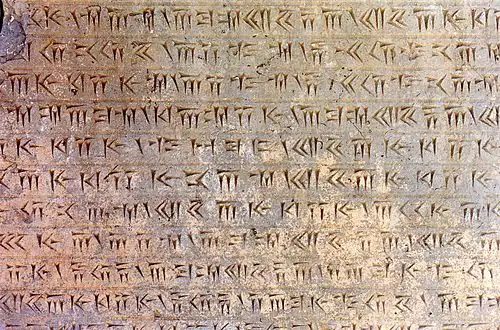
Old Persian (the language of the Achaemenid Empire) was written in a distinct cuneiform script known today as Old Persian cuneiform. This script is strongly associated with the Achaemenid royal inscriptions, and it appears most famously on monuments and tablets from sites such as Persepolis (Takht-e Jamshid), along with other imperial locations. It is commonly stated that Darius the Great ordered a writing system to be prepared for Old Persian so that the language could be recorded in an official and consistent form. In historical discussions, Old Persian cuneiform is often described as being influenced by earlier cuneiform traditions in Mesopotamia, where Sumerian and Akkadian writing systems had already existed for centuries. Main features of the script Old Persian cuneiform has a relatively small and organised set of signs compared with older Mesopotamian cuneiform systems. It is typically described as including: 36 phonetic signs word-divider signs (used to separate words) […]
Encyclopediaدانشنامه
A comprehensive collection of articles introducing notable figures, lands, maps, and cultural heritage of Iran and beyond. This category serves as a reference section for extended information and historical context across the site.
مجموعهای جامع از نوشتهها دربارهٔ شخصیتهای برجسته، سرزمینها، نقشهها و میراث فرهنگی ایران و جهان. این بخش بهعنوان مرجعی برای توضیحات تکمیلی و زمینههای تاریخی در سراسر سایت استفاده میشود.
Continue reading Encyclopediaادامه مطالعه دانشنامه

The “Central Iranian Sea”: a Historical–Environmental Overview Focused on Drying and Its Social Impacts
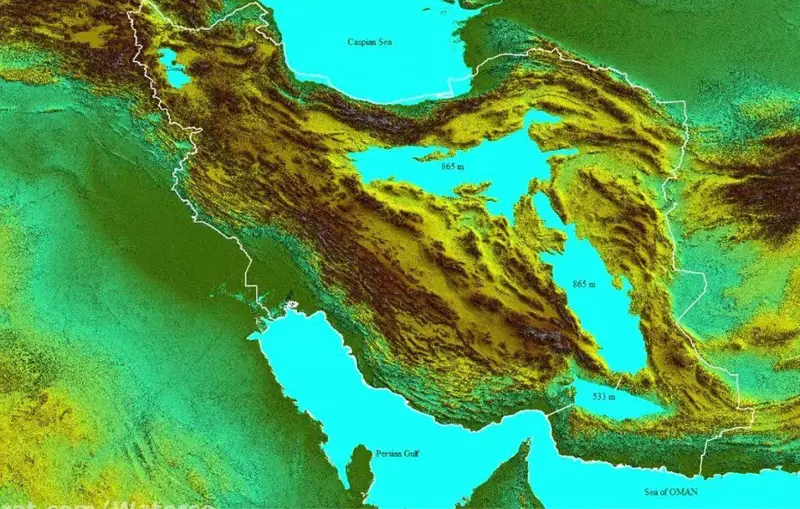
Iran's former central sea on the map
The “Central Iranian Sea” is a shorthand for the superposition of several inland lakes and playas at the heart of the Iranian Plateau (the Namak Lake basin, Hoz-e Soltan, Dasht-e Kavir, etc.). During the colder, wetter phases of the Quaternary these water bodies expanded; during the warmer phases of the Holocene they retreated. That gradual desiccation was not merely a physical trend—it triggered a cascade of environmental changes (soil salinization, higher evaporation, instability of surface water) that directly reshaped settlement patterns, agriculture, migration routes, and water-management innovations around the basin—most notably in the Sialk region. What was the Central Lake? (A natural “advantage” that gradually turned into a “risk”) Extensive geomorphic evidence—lake terraces, broad travertine fields, and wide pediments—shows that, at times, interconnected water bodies linked Hoz-e Soltan, Namak Lake, and the “Dry Sea of Saveh.” Three shoreline base levels at 790/800/900 m remain along the margins, marking former lake […]
Hassan Pirnia
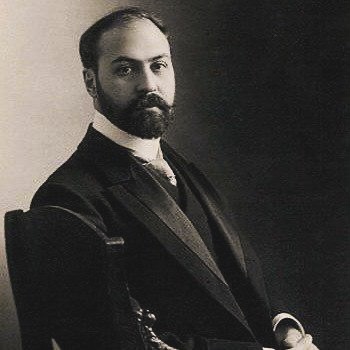
hassan pirnia image
Biography: Family and Education Hasan Pirnia (1250–1314 SH / 1871–1935 CE), born in Na’in, was the son of Mirza Nasrollah Khan Moshir al-Dowleh, the first prime minister (ra’is al-wozara) of the Constitutional era. Hasan completed his early schooling in Iran, then went to Moscow for military and legal studies: he graduated with top honours from the Military School and continued at the Faculty of Law, Moscow University. Returning to Iran, he entered the Ministry of Foreign Affairs as a senior secretary and translator. He was fluent in French, English, Arabic and Russian, acquainted with Classical Greek, and—at 58—taught himself German to consult texts first-hand. [1] Role in the Constitutional Movement and Political Beginnings On the eve of the Constitutional Revolution, Pirnia took an active role in translating and drafting the electoral by-law and the constitution; together with his brother Hossein (Mo’tamen-al-Molk), he is remembered as a “technical architect” of core […]
Sialk
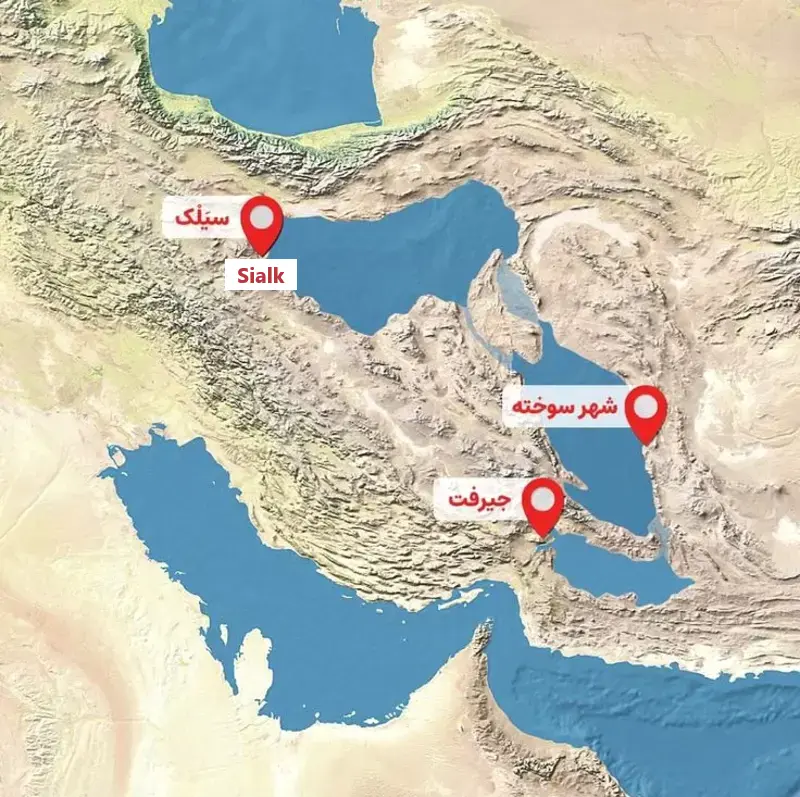
Sialk on the map
Tepe Sialk: The Earliest Urban Hub of Iran’s Central Plateau Identity & Location Name: Tepe Sialk (Read more on Wikipedia) Type: Ancient city–temple archaeological complex (two mounds + two cemeteries) Location: Isfahan Province, Kashan, Fin district (SW of Kashan, right side of the Kashan–Fin road) National Registration: No. 38, 24 Shahrivar 1310 (15 Sep 1931) Why Sialk Matters Sialk is among the most important archaeological sites on the Iranian plateau and one of the oldest known settlements in Central Iran, preserving a long cultural sequence from the Neolithic through the Chalcolithic, Early Urban, Bronze/Iron Ages, and a Median horizon. The site documents: The emergence of early villages and hand-built houses in the region; Agriculture (wheat, barley) and animal husbandry (cattle, sheep, goat); The evolution of ceramics (from coarse hand-made wares to fine wheel-made vessels with human/animal/plant motifs); The onset of metallurgy (copper extraction/smelting; furnaces on the south mound); Evidence of […]
Zabihollah Mansouri
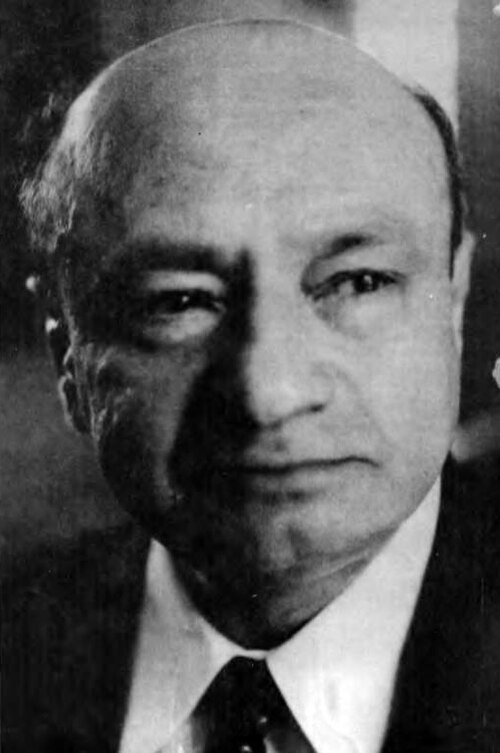
image of Zabihollah Mansouri
Zabihollah Mansouri: Between Translation and Imagination Zabihollah Hakim-olahi Dashti, known as Zabihollah Mansouri (1900–1986), was one of the most prolific translators, journalists, and writers in the history of modern Iran.A complex and controversial figure, he devoted over sixty years of his life to writing and translation — blurring the boundary between translator and author in a way that continues to provoke both admiration and criticism decades after his death. Early Life and Education Zabihollah Mansouri was born in 1900 in Sanandaj, in western Iran.His father, Esmaeil (known as Entekhab-od-Dowleh), was a government employee, and his mother came from a respected clerical family in Gilan.He studied at the Alliance Française School in Sanandaj, established by the French to promote their language and culture, and later, after the family moved to Kermanshah, he learned French under the guidance of a local physician fluent in the language. When the family returned to Tehran, […]