We now arrive at a period in the life of the Iranians which is the beginning of the heroic age, and that which caused the Iranians to decide to adopt the heroic way of life was the invasion of foreign tribes.
At that time, the land of Iran was composed of a number of nomads (but Iranian nomads) who had moved from one point of Iran to another and, in their new settlements, created a new civilisation that differed somewhat from the civilisation of Sialk.
In the civilisation of Sialk (near present-day Kashan), pottery-making, metalworking, and the domestication of animals existed, but weaving did not exist; and as we have seen, weaving came from Giyan, which was a city near present-day Nahavand.
After the Iranians migrated to Zabulistan and then to Khorasan and afterwards to the southeastern and southern coasts of the Caspian Sea, the recognition of useful plants, the planting of fruit-bearing trees, seafaring using sails, and later mountain settlement were added to Iranian civilisation; nevertheless, they remained separate from one another, and each Iranian mountain-dwelling group formed an independent society, although they were one in terms of race.
However, the invasion of foreign tribes—especially the Turanians from the east, the Uzes from the north, and in a later period the invasion of the Qaz tribe from the Caucasus—brought the Iranian societies closer together so that they could defend their existence against the invading tribes.
Until the heroic age began, all the rulers of Iran in all societies—both the early societies (such as the societies of Sialk and Giyan) and the nomadic societies (such as the peoples of Zabulistan, Khorasan, and parts of Mazandaran)—were women, and Iranian civilisation came into existence under the guidance of women.
It may be unacceptable to some that women ruled in ancient Iran and that men obeyed them; however, this is a reality and cannot be denied.
After the female rulers of Iran, through their great intelligence, established the foundations of Iranian civilisation and protected the Iranian peoples from various dangers, they relinquished their position to men, because as a result of the heroic age, men gained authority over women and sovereignty passed from women to men.
The Uzes, who forced the inhabitants of the Caspian Sea coasts to abandon their dwellings and settle in the mountains, also attacked the region that is today known as Khorasan.
Zabulistan was also subjected to attacks from the east by the Turanians, and every so often the Turanians would invade Zabulistan, force the Iranians to migrate, and after destroying everything would return to their place of origin, and the Iranians would return after the departure of the Turanians.
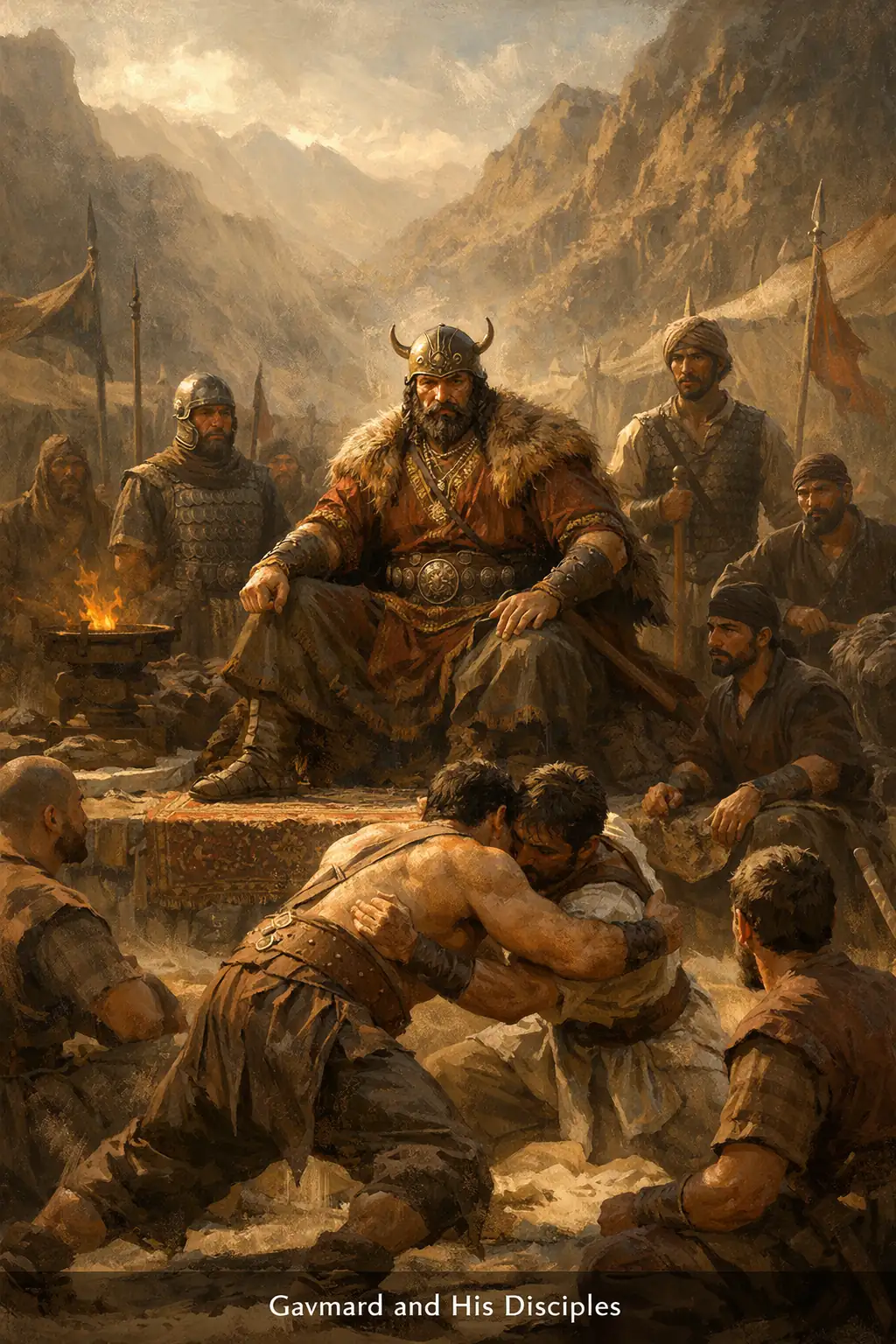
Because Zabulistan and Khorasan were under constant danger, the Iranian tribes living in those two regions drew closer to one another and formed a government under the leadership of a man named “Gāvmard.”
Gāvmard was a hero and had a number of apprentices who were trained under his supervision, and after reaching the level of mastery, they trained other apprentices.
The skills that had to be learned consisted of throwing stones, using the sword and axe, and grappling by grasping the opponent’s belt in order to throw him to the ground; that belt was called “koshti,” and it is the same belt which later became one of the elements of religious observance in Iranian Mazdaism and which the Arabs called “zunnar.”
The training grounds of the heroes of Zabulistan and Khorasan were vast plains, mostly at the foothills of mountains. During favourable seasons, the Iranian training grounds were green plains, and in winter they practised in covered places.
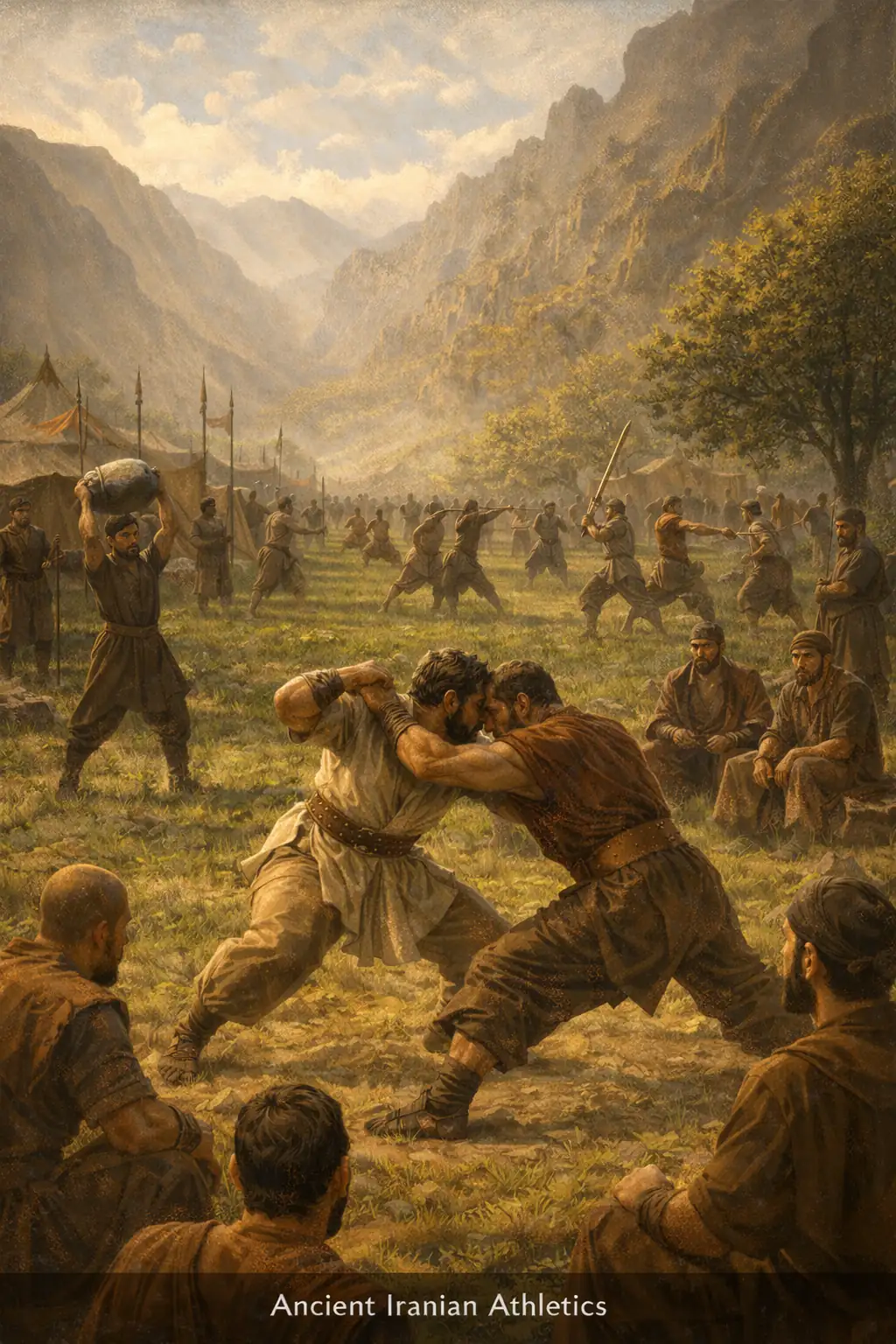
The “Olympiad,” contrary to common belief, did not originate in Greece; rather, the Iranians were the first to establish the custom of exercising in open spaces, and this custom, like many elements of civilisation, spread from Iran to the Western world and became common there.
Ferdowsi, the composer of the Shahnameh, considers Gāvmard (Keyumars) to be the one who taught cooking and weaving to the Iranians, and in a comprehensive sense, “Gāvmard” was the first leader of Iranian civilisation.
Gāvmard was the first athletic instructor in ancient Iran. Until that time, the occupations of men and women were not separated, but after the heroic age began, the profession of Iranian women became separate from that of men—not because women were incapable of performing men’s work, but because it was necessary for women to attend to other important tasks.
Because the invasions of foreign tribes occupied men to such an extent that they could no longer engage in agriculture or animal husbandry and, naturally, could not care for children, men became so involved in warfare that even metalworking was entrusted to women, and they forged swords for men to be used on the battlefield.
