Alexander, after he entered Iran and saw the things that Cyrus had done and heard from the Iranians, realised that no one should demean or insult a religion on the grounds that it is not his own religion.
Another of the great examples that Alexander took from the Iranians was public education. When he entered Iran, he observed that all Iranians could read and write, whereas in Greece reading and writing and the acquisition of knowledge were restricted to a handful of people; therefore he set out to make reading and writing public in Greece as well.
While reading these lines, this question comes to mind: if reading and writing were so prevalent in Iran, why were some classes deprived of reading and writing at the end of the Sasanian period?
There is no doubt that at the end of the Sasanian period some classes were deprived of reading and writing, and even if they attempted to learn reading and writing they would be regarded as criminals; but that practice was prevalent in the south and west of Iran, not in the north and east, and in the northern and eastern provinces all classes benefited from reading and writing.
In any case, Alexander sought, in imitation of the Iranians, to make reading and writing public in Greece, but his life did not last long enough for him to put that idea properly into effect, and after his death his successors set that idea aside.
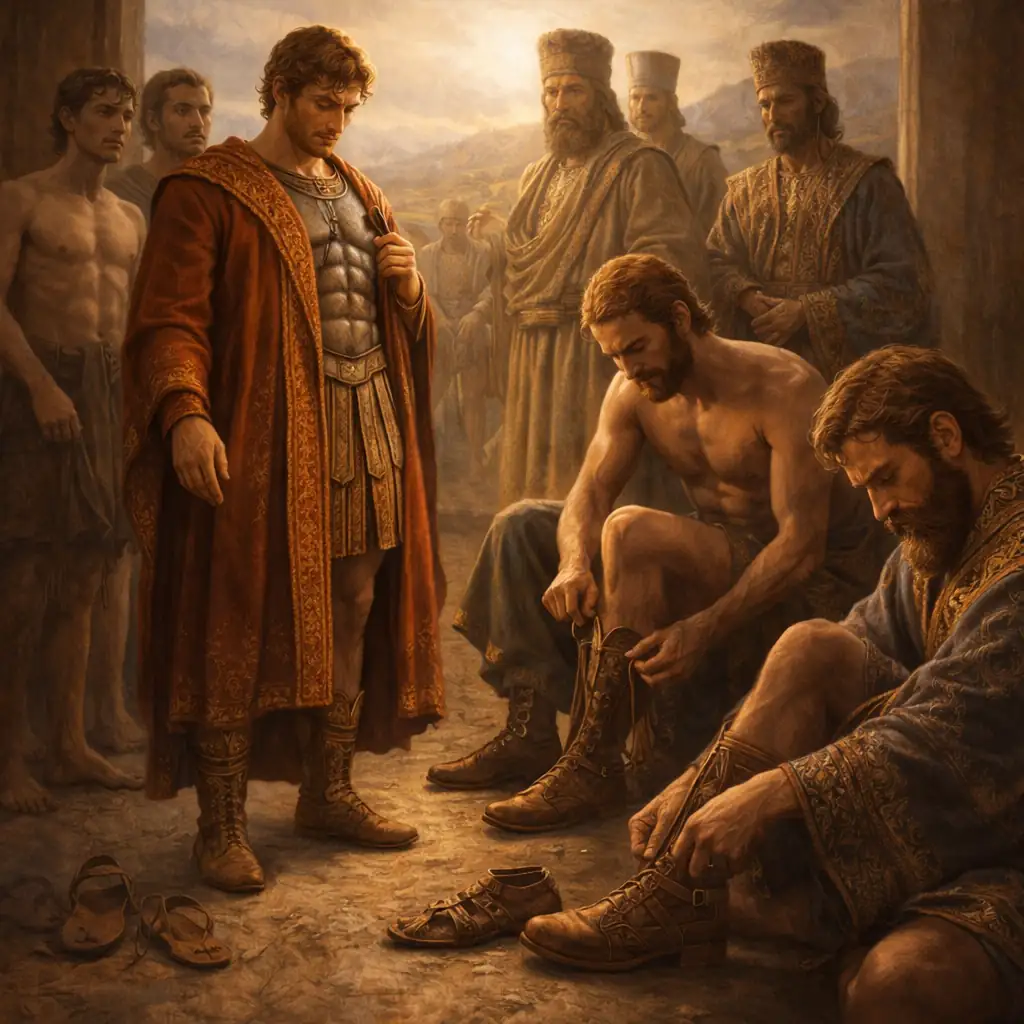
Another of the things that Alexander and his companions adopted from the Iranians was the custom of wearing fine clothes and putting on real shoes. Alexander and his companions wore clothes that continually made them appear half-naked, and their shoes were a flat piece of wood that was attached to the foot by means of a strap or rope. When they entered Iran and saw the clothes and leather boots of the Iranians, they were captivated, and they threw away their wooden shoes and put on Iranian boots, and they wore the beautiful long clothes of the Iranians that were sewn with taste.
The longer Alexander and his companions remained in Iran, the more he and those around him realised the importance and value of Iranian civilisation, and when Aristotle wrote to his student Alexander asking why you do not return to Greece, Alexander replied that if you too come to Iran you will become bound, like me.
Alexander and his companions, after they entered Iran, also became enamoured of the delicious foods of the Iranians.
The Greeks were very primitive in the art of cooking and had no spices and did not know some vegetables and legumes.
A portion of the legumes and vegetables that are seen in Europe today, and about whose Iranian origin there is no doubt, went to Greece after Alexander came to Iran and from there entered other countries.
The Greeks could not make their foods delicious with various vegetables and legumes and spices.
But in Iran there existed various grains and legumes and vegetables and animals (whose meat is edible) and kinds of spices, and the people of that land cooked delicious foods, and the Greeks learned cooking from the Iranians.
After Alexander had remained in Iran for some time, he could not eat any food other than Iranian food, and he completely abandoned the sour-tasting Greek kashk and the unsalted roasted meats of his homeland, and he became so accustomed to Iran that when they brought him the news of the murder of Darius III, the king of Iran, he wept and said, since I was the cause of his murder, I cannot forgive myself.
Was Iranian society cave-dwelling?
In answer we say yes, because the skeletons of Iranians have been found in the caves of Iran, but the Iranians abandoned cave-dwelling seventeen thousand years ago and became house-dwellers, whereas some Europeans were cave-dwellers even until six hundred years before Christ.
Today, placing bricks on top of one another and creating four walls and laying beams on the walls and then making a roof appears easy and ordinary to us, but if the ancient Iranians had not taught house-building to the peoples of the world, perhaps even today some peoples would be living in caves, because the intellect of the ancient peoples did not reach house-building and they could not build houses by piling stones or bricks on one another.
We do not know whether Iranian builders invented the art of building houses themselves or learned it from some animals, but we know that the first houses were built in Iran and it was they who built houses by means of clay and stone and wood and in later periods by means of bricks.
Just as the first furnace for smelting metal was built in Iran and its trace exists today and a technical test by means of carbon-14 proves its antiquity, the first brick-kiln in the world was built in Iran and its trace exists today.
These are not suppositions and guesses but indisputable historical reality, and the civilisation of Iran in periods when other peoples lived as savage or semi-savage and some of them were cannibals was so brilliant that they used baked bricks to build houses.
The historical discoveries that have been made in Iran are recent, and for the past one hundred years European and American travellers and researchers have set out to undertake exploration in Iran and, through excavation, to understand Iran’s historical standing.
But for a time the work of the excavators was the work of amateurs, that is, they excavated for recreation and to pass time, not that they undertook excavation seriously, and serious excavations by history experts began in Iran thirty-five years ago, and thirty-five years for historical excavation in a country like Iran whose historical background goes back seventeen thousand years is a short period; and according to “Roman Ghirshman,” the French historian and excavator, there are hundreds of mounds (tells) in Iran under which the ruins of ancient cities lie, and the opportunity to explore them has not yet been obtained, and besides opportunity, extensive funds must also be allocated for excavation in various parts of Iran.
If a broad programme for excavation in Iran, for the inference of historical truths, is put into effect, it is not unlikely that the origin of Iranian civilisation will go back even further, because, as we said, when we consider the origin of Iran’s civilisation (to the extent that can be understood from historical evidence), we see that it is a civilisation that is fashioned and developed, and civilisation did not come into existence all at once but gradually became accompanied by development, and perhaps after extensive historical discoveries in Iran the origin of Iranian civilisation will go back to twenty and twenty-five and thirty, even forty and fifty thousand years, and if it is not taken as exaggeration, to one hundred thousand years.
Professor “Fry,” the contemporary American Iranologist, believes that the Iranians lived in a land whose natural conditions were not suitable for cave-dwelling, and throughout Iran perhaps there were not more than two habitable caves, and it is not unlikely that this was among the factors that compelled the Iranians to build houses.
At the beginning of civilisation, every action undertaken by humankind was out of need, and even today, in the twentieth century, unless people’s need compels them to do something, it is unlikely that they will undertake that thing.
This need caused the Iranians to think early about house-building and to create buildings first with clay and then stone and then bricks and baked bricks, and the buildings that the Iranians created endured for a short time and sometimes for the length of an average person’s lifetime, and some walls that in recent periods in Iran were built with clay still remain after two hundred years.
The Iranians used to mix clay with pebbles and would select a special kind of soil for making clay that, after drying, became very firm.
The Iranians were able to lay beams over their houses and then cover the roof of the house, and to obtain the roof beams from the poplar tree, which is a native Iranian tree and went from Iran to other countries.
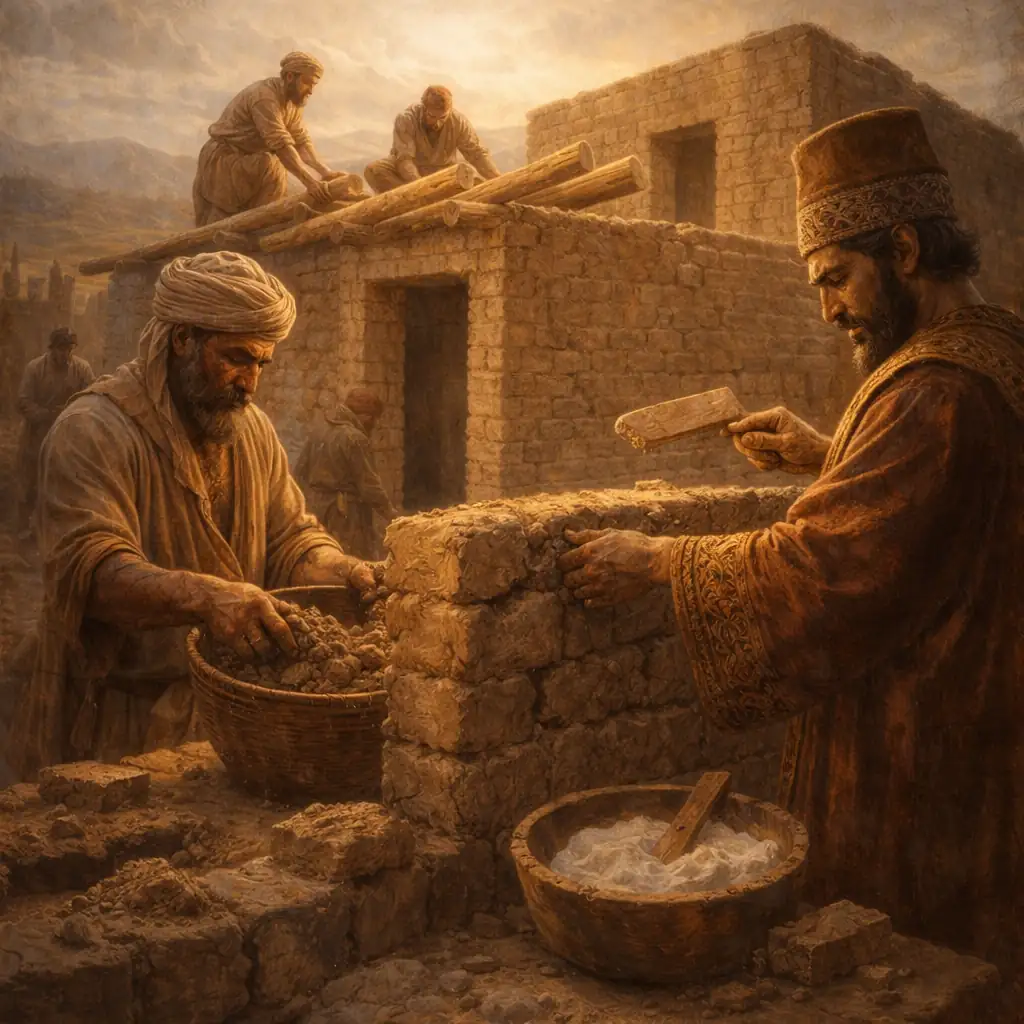
The Iranians learned the art of building houses earlier than all the peoples of the world, and gypsum and lime were first discovered in Iran, and for the first time the genius of the Iranians perceived their benefits for house-building, and it is astonishing that some European experts have said that the use of gypsum and lime was among the innovations of church builders.
We know that the builders and building workers of Europe, in the era when Europeans were engaged in building churches, formed for themselves a union or syndicate. In that period thousands of churches were built in various European countries, some of which still remain, and even today, when people have become accustomed to seeing skyscrapers, the sight of those enormous churches still produces astonishment and admiration in them.
In the era when churches were being built in Europe, the number of builders and building workers was so great that they formed a large class, and the members of that class, due to unity of interests, drew close to one another and formed a syndicate so that they might receive wages in return for their work and not be forced to submit to corvée (unpaid labour).
This occupational syndicate, which was called “Freemasonry,” meaning free builder, was initially formed to secure the interests of builders and building workers, but, as we know, later it changed its nature and became a political and aristocratic club.
If the theory of some Europeans is taken into consideration, it must be said that before this era, that is, before the period when building churches became fashionable and common in Europe, gypsum and lime were not used; whereas “Dieulafoy,” the French scholar and researcher who excavated at Susa in the time of Naser al-Din Shah, established the use of gypsum and lime in ancient Iran.
In Dieulafoy’s time the technical means of today for determining the antiquity of historical remains did not exist; nevertheless Dieulafoy said that in Susa gypsum and lime had been used three thousand years before him, and the formation of the builders’ union in Europe dates back one thousand years.
Thousands of years after the Iranians invented house-building, the peoples of the West began to build houses and made shelters for themselves out of wood in lakes.
But just as the Iranians are the first innovators of house-building, they are also the first innovators of building houses with wood, and the building of wooden houses and covering the roof of the house with dried grass called gāli is among the innovations of the Iranians, and other peoples learned that craft from the Iranians as well. In any case, the art of building houses with wood is also among the inventions of the ancient Iranians, and even today one can see in northern Iran examples of those houses with roofs covered with dried grass.
