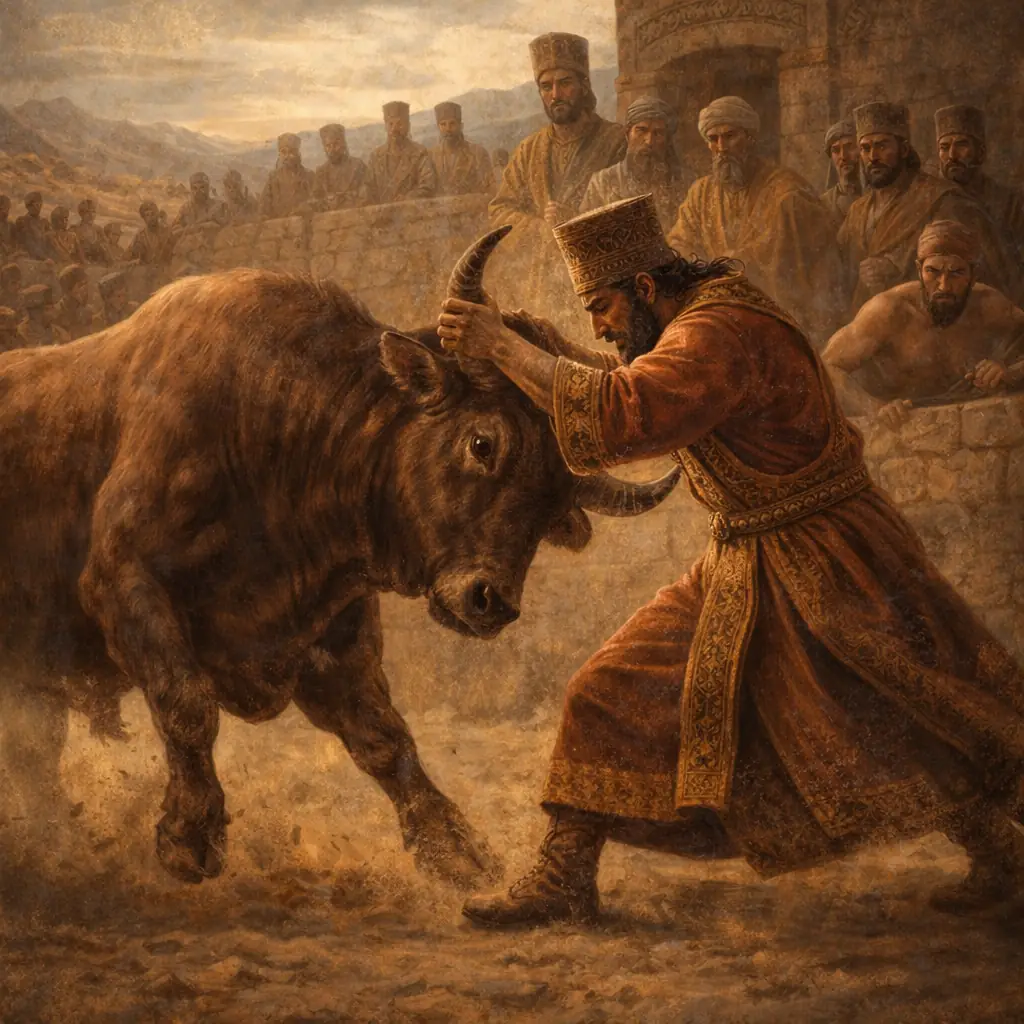
In the civilisation of the island of Crete, the cow, whether male or female, was of great importance, and the inhabitants of Crete also learned this from the Iranians, who were the first settlers of that island.
Since the ancient Iranians regarded the cow as a useful animal, after the domestication of animals became common they strove to keep it, and the fact that we see the name of the cow used in part of the names of ancient Iranians was due to the Iranians’ special attention to that animal.
The ancient Iranians ploughed the land with the bull and used the milk of the cow, and they used the bull for riding and carrying loads, and bullfighting, which people imagine to be a Spanish sport, was an Iranian sport, and bullfighting in Iran may have a history of ten or fifteen thousand years; but Iranian bullfighting was not in the form that is seen in Spain in this era, and the ancient Iranians did not kill the bull in the bullring and did not torment it, but rather they played with the bull to display their strength and agility, and in the Shahnameh too reference has been made to the bullfighting of the ancient Iranians.
The bullfighting of the Iranians went from Iran to the island of Crete and preserved its originality there, and the inhabitants of Crete played with the bull to display their strength and agility without killing the animal; and since in the country of Iran men were strong and agile, Iranian women also bullfought, and this custom remained preserved on the island of Crete, and the ancient motifs of the island of Crete show that women bullfight.
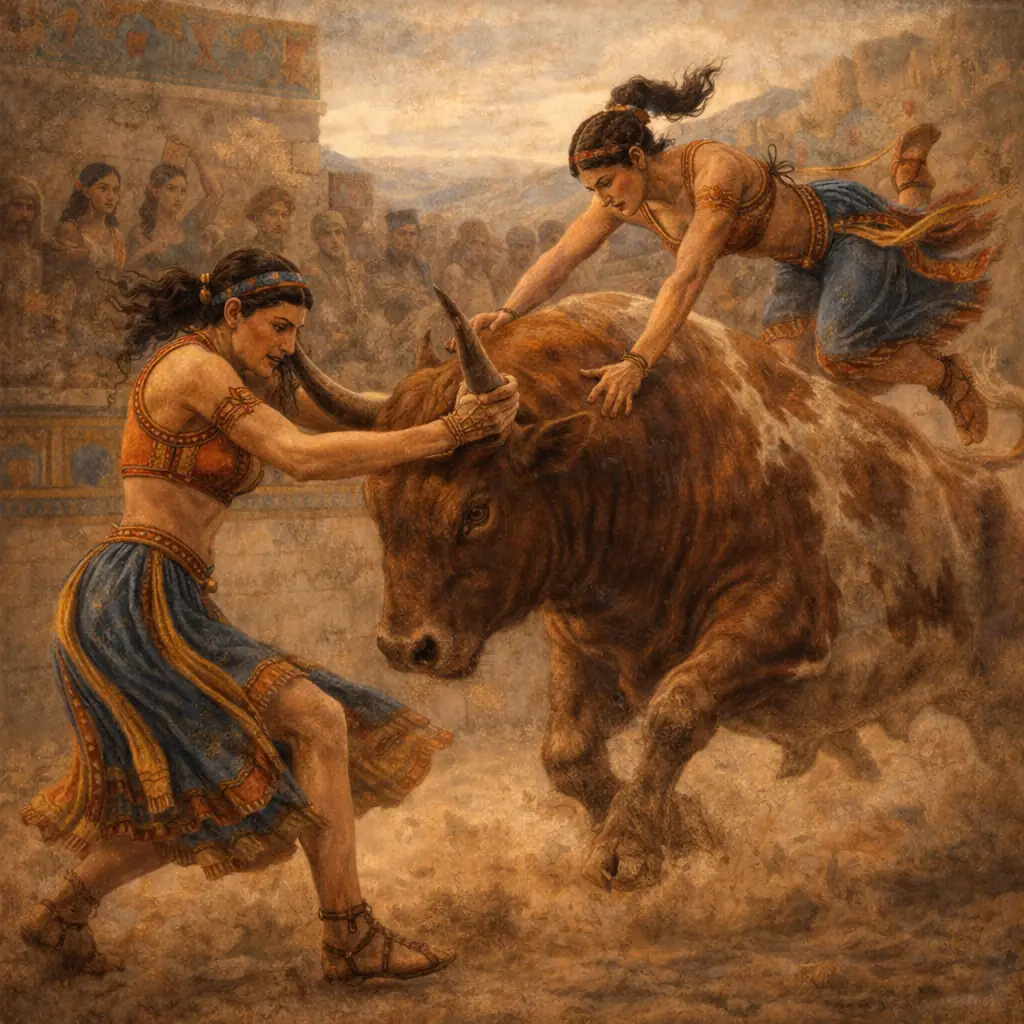
The custom of bullfighting on the island of Crete was made common in Spain by means of a settler from the inhabitants of that place, and in that country bullfighting took the form that is seen today and of which everyone is aware and which does not require elaboration, and it is not unlikely that in other Iranian colonies in Europe too the custom of bullfighting was common.
In these pages we bring our discussion concerning the pre-historical times of the life of the Iranians to an end, and from now on we shall enter historical times; but it must be known that what we said concerning the pre-historical times of Iran was a part of the whole.
But before bringing the discussion relating to the pre-historical period to an end, it is necessary to point out this point that the Iranians, before others, sailed around Africa by sea, and before others they were able to reach northern Europe by sea and arrive at a place where perpetual darkness prevailed.
Until recently everyone said that the first time the Europeans went around Africa by sea was (and when they began their voyage they saw that the sun rose on their left hand, and when their voyage ended and they approached Gibraltar they observed that the sun rose on their right hand).
This statement was a historical principle, and not accepting it is considered, from the historical point of view, as unbelief.
Nevertheless, in the history written by Western historians it is written that the first seafarers who were able to reach northern Europe by sea were some Europeans; but from some time to this side, since clear, indisputable remains of Iranian colonies on the island of Crete and on the coasts of Italy and the coasts of the island of Sicily and the coasts of France have appeared, and it has been established that the Iranians, in periods before Christ, had colonies on the northern coasts of the Mediterranean Sea, Western historians must lessen their prejudice and accept the reality.
The reality is that before the Europeans travelled around Africa and before they were able to reach North Africa by sea, the Iranians travelled around Africa and reached northern Europe by sea and discovered the region of darkness.
The Iranians knew that the earth is round, but they were unaware of the movement of the earth around the sun, and they wanted to reach the other side of the earth; therefore they set out to move along the coasts of Africa so that they might reach the other side of the earth, and the commander of the sailors who undertook this voyage was an Iranian man named “Zab-sin.”
Regarding this event, certain things existed in the Vatican Library, and “Vasco da Gama,” the famous seafarer, as a result of reading those notes was able to sail around Africa and reach the East. He reasoned that since the Iranians had been able in ancient times to set out from eastern Africa and sail around it in order to reach western Africa, then he could begin his voyage from western Africa and reach eastern Africa, and when he reached there, going to India would be easy, because the ocean that moistens the eastern coasts of Africa and the coasts of India is one and the same.
Everyone knows that “Christopher Columbus,” as a result of reading materials that were in the Vatican Library (the library of the Papal court), conceived the idea of travelling around the earth and reaching the East by way of the West, and those materials related to the voyages of Iranian seafarers who believed that the earth is spherical.
The belief in the earth’s sphericity went from Iran to ancient Egypt, and the ancient Egyptians also knew that the earth is spherical.
The belief in the earth’s sphericity has an Iranian origin, and perhaps the ancient Iranians, who knew that the earth is spherical, like Christopher Columbus and Magellan in later ages, set out to travel around the earth, but we have no evidence to prove this assumption.
Christopher Columbus is not the first discoverer of America either, and before him Scandinavian seafarers and before them Muslim seafarers who lived in Africa had gone to America, and the reasons for proving that Muslims had discovered America hundreds of years before Christopher Columbus are so many that if they were mentioned it would cause prolixity, and briefly we say that when Christopher Columbus discovered America, in some places in America an African Arabic dialect was common, and some places in America had Arabic names, and a number of Africans lived in America, because the Muslims had taken them with them to America.
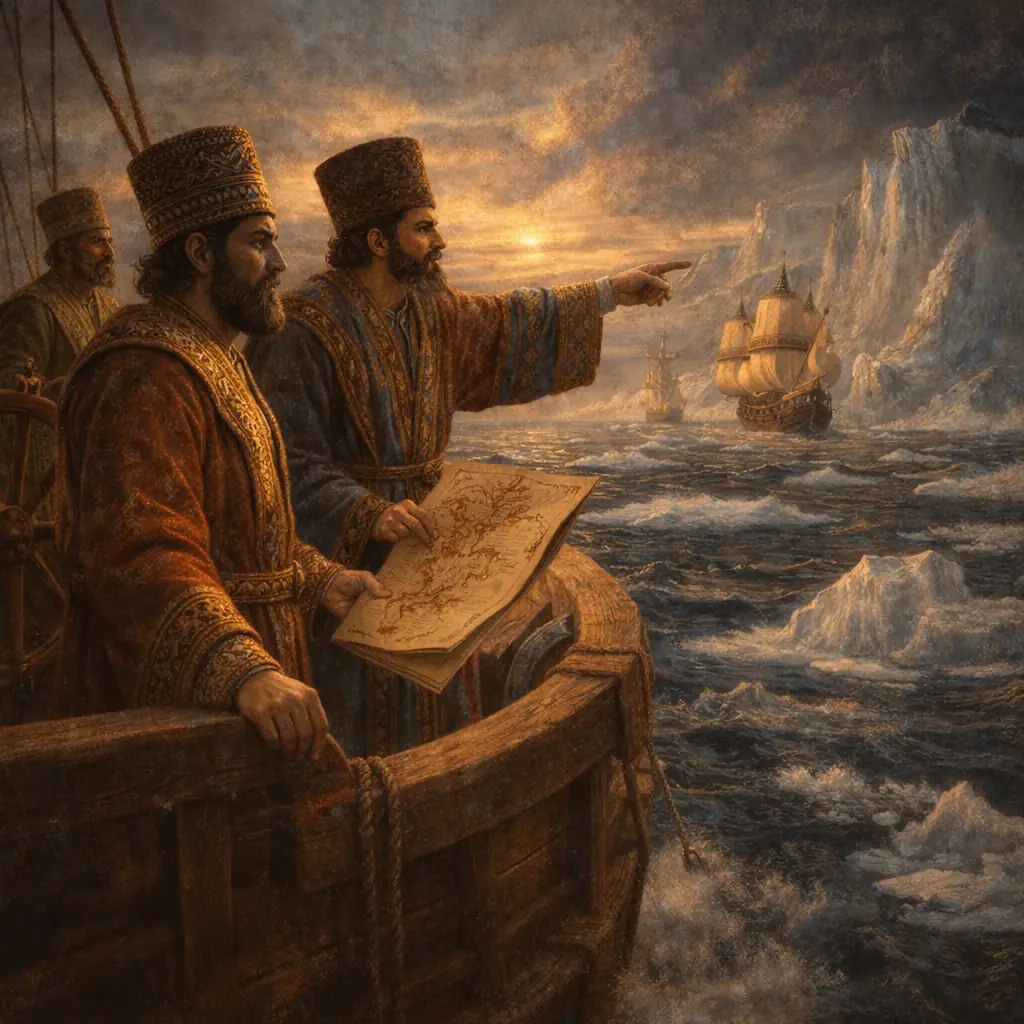
In any case, Vasco da Gama and Christopher Columbus, as a result of reading the notes relating to the voyages of Iranian seafarers in the Vatican Library, realised that one can reach India by way of Africa or travel around the earth.
Another of the outstanding deeds of the Iranians was that Iranian seafarers were able to reach northern Europe by sea. The date of this voyage, like all events of the pre-historical period, is not known with certainty, but its trace remained in the Vatican Library.
A group of Iranian seafarers set out from southern France, and after passing through the Strait of Gibraltar and entering the Atlantic Ocean, then turned northward and went on until they reached a place that was a land of cold and darkness.
We know that near the polar region the air becomes extremely cold and from the autumn season onward darkness prevails there, and the Iranian seafarers who for the first time reached the region of perpetual cold and darkness, after returning from that journey, related their observations to others, and what they saw and felt reached other peoples in the form of legend and reached Babylon and Egypt, and the effect of that legend is in all the stories of ancient peoples.
After the Iranians others set out to pass through Gibraltar and enter the Atlantic Ocean (which was called the Black Sea and should not be confused with the present-day Black Sea between the Soviet Union and Turkey).
But they were imitators of the first Iranian seafarers, and the Iranians were the first to reach the cold, frozen, and dark region of the seas of northern Europe.
Was it sightseeing or trade that compelled them to undertake that voyage?
Did they want again to test the sphericity of the earth, or did they go in order to discover the European peoples who live in the north of that continent and trade with them?
In ancient times all sea voyages had an economic and commercial cause, and even most probably the voyage of the Iranians around the continent of Africa was not without a commercial and economic purpose, and perhaps the hope of benefiting from effective factors was the motive for the voyage of Iranian seafarers to the north of the continent of Europe.
We say nothing more regarding the means related to the pre-historical periods of Iran, and henceforth our discussion will relate to historical periods, part of whose events have been recorded in books and another part in the last half-century has been extracted from the soil and inferred, whether in Iran or in other countries of the Middle East.
We extract from books to the extent of our ability, because we do not have access to all those books, especially those in Greek and Latin.
The German “Max Müller,” who in the nineteenth century AD was among the great researchers of the history of the East and Iran, said that in the libraries of Europe and China there exist approximately four thousand books about the ancient history of Iran whose contents have not yet been made known to the public.
For some time now efforts have been made to compile a catalogue of the books relating to the history of Iran that exist in Western libraries, and it has become known that the number of books is more than what Max Müller had said, but that researcher considered only the Latin and Greek and Chinese books, not the books written in living European languages about the ancient history of Iran, and even if those books should come to us, since we know neither ancient Greek nor Chinese, we cannot make use of those books. But most European and American researchers who have researched the history of Iran, of course, know ancient Greek and Latin and have reflected part of the contents of those rare books in their own books.
We humbly admit that we do not even have access to all the books of European and American researchers written in today’s living languages, but our effort will be to place a correct and precise history of our homeland at the disposal of honoured readers.
According to an approximate survey that has been carried out in recent years, regarding the ancient history of Iran there exist one hundred and fifty thousand books in the world, four thousand of which, according to the German researcher Max Müller, are in Greek and Latin and Chinese, and the rest are in English and French and German and Italian and Russian and Turkish and Arabic, and some of them are ten, fifteen, or twenty volumes, and reading them requires long years of time.
But since we make use of the harvest of others’ learning and others have undertaken the labours of study and research, we can make use, beyond the proportion of our own time, of the books that have been written about history.
We said this so that those who are people of history may realise that we have no baseless claim, but we endeavour, in the historical periods, to inform readers of events of which the public may perhaps be unaware.
