
Some time before the Achaemenid dynasty began to rule in Iran, and even some time before the Medes began to rule in Iran (in the north-west and west), Iran had a king named Gath.
We do not know whether Gath is the same Zoroaster who composed the Gathas, which have survived to this day, or whether he was another person.
There is no doubt about the existence of Zoroaster and Gath, but it is possible that ancient historians confused these two names with each other.
Richard Frye, the Iranologist and current professor of Iranian history at Harvard University, who also travelled to Iran this year (the year 1345 in the Iranian calendar), tried very hard to determine the exact time of the reign of Gath or Zoroaster, but he was unable to do so. His estimate ranges from six thousand years before Christ to six hundred years before Christ, and he confirms that there is no doubt about Zoroaster’s prophethood. However, his prophethood was similar to the mission of the first patriarchs, such as Abraham, Lot, Jacob, and others; that is, he was both a prophet and a king.
In a list he has provided, Richard Frye names fifty European Iranologists, especially German ones, who tried to determine the birthplace and date of birth of Zoroaster but were unable to do so. Whatever has been said about the birthplace of Zoroaster, including the area beside Lake Rezaieh, consists of traditions that historical documents do not confirm.

Richard Frye considers the Gathas to be the oldest literary work in the Persian language and says that perhaps for hundreds or thousands of years the Gathas were transmitted orally, from person to person, until writing was invented and they were able to write them down.
Gath ruled in Iran during a period when Iran had colonies along the northern shores of the Mediterranean Sea, and he, Sardi Basudeh, was very interested in construction and the development of agriculture, and wanted to introduce Iranian agricultural methods into Europe and lead the European tribes.
The oldest historian of the Western world, who lived before Herodotus the Greek and was called “Xanthus”, from the country of Lydia, says the following about this king:
“Then he moved a group of farming men and women from the land of Gil, situated in the far west of Europe, and settled them beside the Caspian Sea; and he moved a group of farmers from beside the Caspian Sea and settled them in the land of Gil.”
Without having to go deeply into historical documents, one can understand that the land of Gil, situated in the far west of Europe, is the same land that later became known as “Gaul” and is today called France.
The ancient French had no knowledge of rice, and Gath moved a number of farmers from the shores of the Caspian Sea (the region that today is called Gilan) and sent them to France so that they could teach the French the method of planting rice. He also moved a number of farmers from France and settled them in the Gilan region so that they could become familiar with the secrets of Iranian agriculture.
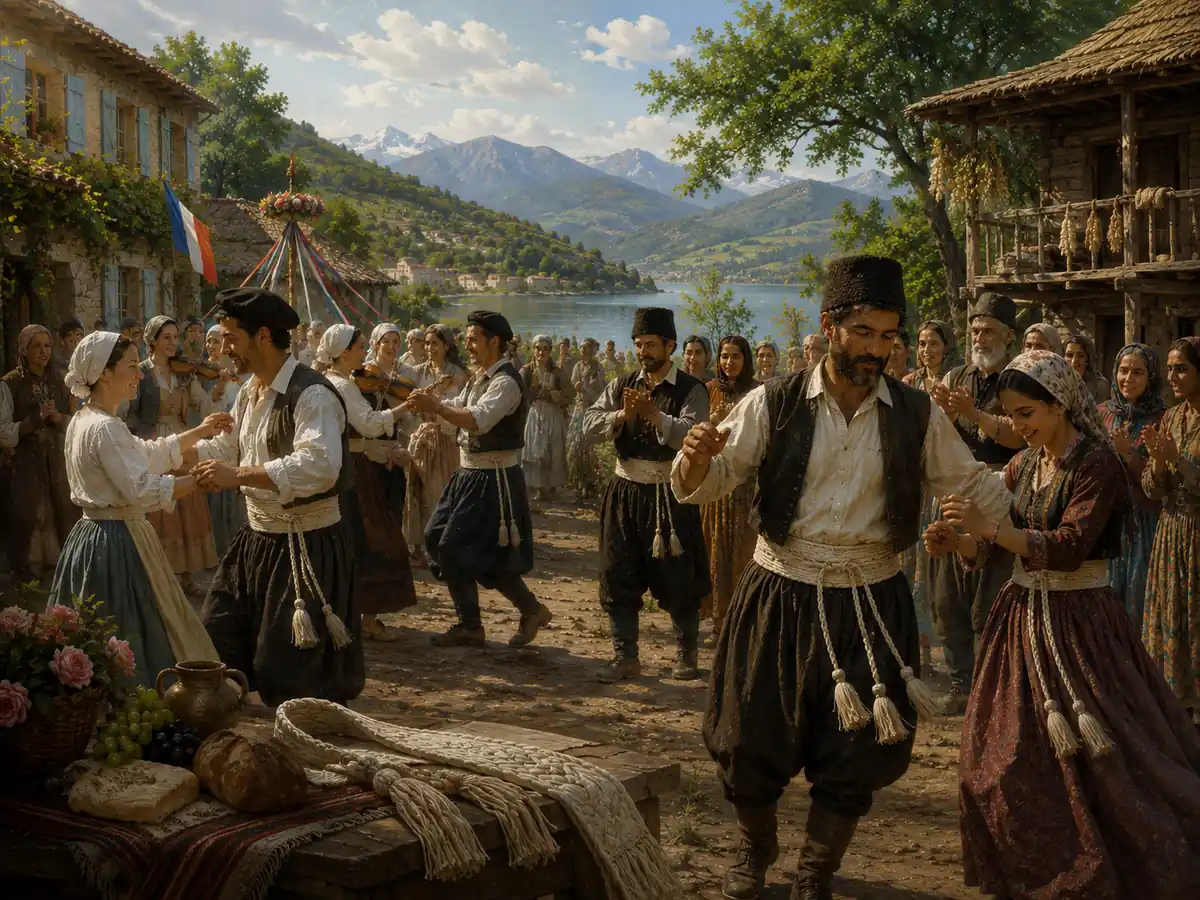
Even today, anyone who enters a village in southern France and carefully observes the way of life of the villagers, and then travels to Iran and enters a village in Gilan, will be astonished to see that the way of life in both villages is the same. Apart from certain industrial inventions such as tractors, combines, and automobiles, the villagers of southern France and the villagers of the Gilan region live in the same way. Even the villagers of France, during their local festivals, like the villagers of Gilan, tie a kusti around their waist; and the kusti was a special religious sign of ancient Iranians, which later became known as the zunnar. They tied the kusti around the waist like a belt, and its end hung down in the form of a tassel.
When you enter a village in southern France, you observe that part of the villagers’ food is a type of special small broad bean, exactly like the one grown in the villages of Gilan. Its method of cooking is the same in both regions: they cook the beans, turn them into a thick sauce, and eat them with eggs.
Another type of broad bean exists in the villages of southern France and Gilan; it is much larger, and they dry it. Sometimes they place it in water so that it soaks and becomes soft, and then they consume it as a salad.
A person who enters the villages of southern France sees long strings of onions and garlic hanging from the ceiling of the house or from the wall, and the same scene can be observed in the villages of Gilan.
The way olives are used in food in the villages of southern France is similar to that in the villages of Gilan. The villagers of southern France mix olives with ground walnuts to make them tasty, and they place another portion of olives in a barrel and put wild pomegranate peel into it so that the colour of the olives turns black and their skin becomes soft. The same custom is common in the villages of Gilan.
Endnote
Those who are familiar with the French language know that in that language the word Gaul, which is the old name of France, is not written with the letter “vav”; rather, they write and pronounce it as “Gael” with a damma on the hamza, and the sound of “vav” does not exist in the word Gaul. In the French text, the word Gaul is close to the word Gil. Translator.
